Choosing a multi-tenant SaaS architecture starts with what your customers need to keep separate: data, access, workloads, and configuration. Tenant isolation must also support recovery, customer contracts, and the team operating the product. Dedicated resources can address specific requirements, but they add cost and maintenance work. Shared resources need explicit controls wherever customer information moves.
Before choosing a model, ask whether you can restore one customer’s data, contain heavy workloads, and verify access across the application. These questions matter more than an architecture label. The following sections compare the models, trace tenant context through workflows, and explain how to evaluate operational trade-offs. Start with confirmed requirements, then validate the assumptions that could make the chosen approach unsuitable.
What Tenant Isolation Actually Means
Tenant isolation prevents one customer organization from accessing another’s protected resources. In a multi-tenant architecture, that protection depends on enforced controls across the system.
Data, Access, Compute, and Configuration Boundaries
Start with the distinction of tenant vs user. A tenant represents a customer organization or workspace; a user is an individual account. A deployment is a running application environment that may serve one or several tenants.
Data boundaries govern ownership and retrieval. Access boundaries determine which actions users and services may perform. Compute boundaries address resource contention, while configuration boundaries keep settings, integrations, and credentials scoped correctly.
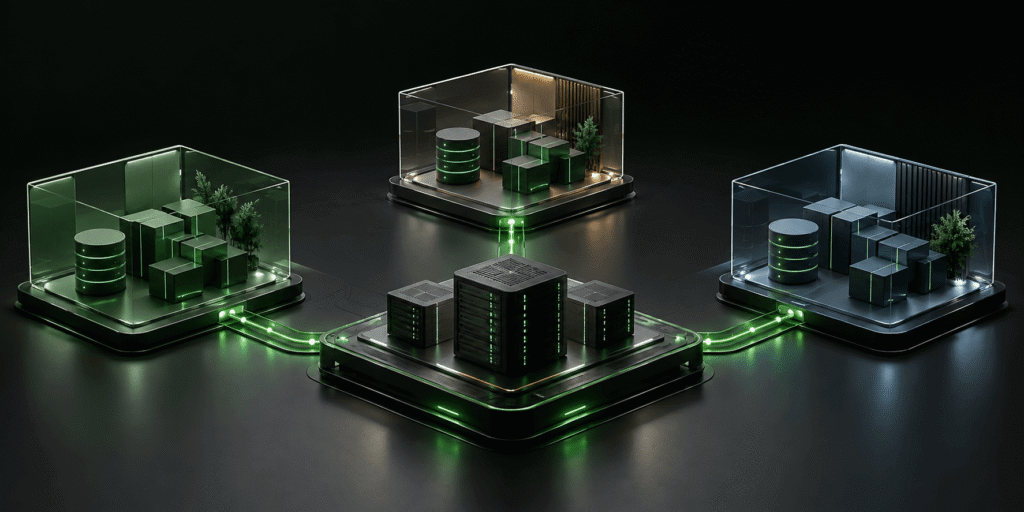
Architecture for multi-tenant SaaS can combine shared and dedicated components. Logical separation uses policies and permissions within shared systems; physical separation uses distinct infrastructure. Neither removes the need to verify access. Microsoft treats these choices as a spectrum with different operational trade-offs.
Authentication Is Not Tenant Isolation
Authentication confirms identity. Authorization determines what that identity may do. Isolation between tenants also requires checking the customer context of each operation. AWS explicitly distinguishes sign-in and authorization from the controls that enforce separation.
Consider a reporting platform: one person is an administrator in Organization A and a viewer in Organization B. Signing in proves identity. Every report request must still verify membership, organization-specific permissions, and report ownership. Adding tenant_id to records cannot enforce those checks by itself.
Define Your Requirements Before Choosing a Tenant Model
A SaaS tenancy model should follow documented requirements. For multi-tenant SaaS architecture, separate contractual obligations from preferences and assumptions. That distinction keeps hypothetical needs from driving implementation.
Customer Contracts, Recovery Needs, and Data Location
Confirm whether customers require dedicated resources, specified hosting regions, or tenant-specific retention. Clarify whether one customer’s data must be restored without reverting changes for others.
Define recovery targets too. Recovery point objective (RPO) describes the maximum acceptable data loss measured in time. Recovery time objective (RTO) describes how quickly service must be restored. Specify whether these targets apply to the platform or an individual customer.
Workload, Customization, and Operational Capacity
For a multitenant architecture, registered-user counts reveal little about resource demand. Compare concurrent requests, dataset sizes, imports, reporting jobs, and usage peaks.
Before approving the model, confirm:
- Which requirements are mandatory?
- Can recovery meet the agreed targets?
- What happens when one customer generates heavy workloads?
- Which customizations need separate resources?
- Who owns provisioning, upgrades, monitoring, and incident response?
VortDev’s multi-tenant platform development process reviews workload, tenant isolation, backup strategy, regional deployment, and operating constraints before selecting the data model. This connects the architecture proposal with customer needs and the team’s capacity to maintain it.
Which isolation model fits your SaaS?
Bring your customer requirements, recovery needs, and expected workload. We’ll discuss the architecture and the trade-offs your team needs to plan for.
Shared Tables, Separate Schemas, or Database per Tenant?
A multi-tenant SaaS architecture can share application services while separating customer data in different ways. The choice affects access controls, recovery, migrations, and infrastructure management. Compare the boundaries each model creates and the work required to maintain them.
Shared Tables with Tenant-Aware Access Controls
In shared tables, tenant-owned records carry an organization identifier. Application authorization and database policies enforce tenant isolation across reads and writes. Queries, exports, and administrative operations must respect the same ownership rules.
This approach can suit products with similar customer requirements and centralized releases. However, restoring one customer usually requires extracting and reconciling tenant-specific data rather than reverting the production database.
PostgreSQL row-level security can reinforce access controls, but the application’s database role matters. Superusers and roles with BYPASSRLS bypass policies; table owners normally do too. Test the actual production role, not just the policy definition.
Separate Schemas Within a Shared Database
A schema per tenant groups each customer’s tables within one database. It creates a distinct namespace, but permissions and application routing must enforce isolation between tenants. Selecting the wrong schema can still expose another customer’s records.
This model may fit teams that need separate data structures without managing individual databases. The trade-off is repeated migrations, schema version tracking, and more complicated tenant-specific recovery. Compute, connections, and other database resources remain shared.
Database per Tenant
Choosing a database per tenant separates customer datasets into individual databases. Credentials, connection routing, and permissions must ensure that requests reach only authorized resources.
A database-per-tenant model can support independent data management and recovery, depending on the database service’s capabilities. It also introduces provisioning, connection management, monitoring, and migration work across a growing database fleet.
Separate databases may run on the same server or cluster. That arrangement does not automatically eliminate resource contention or shared infrastructure failures.
Hybrid Models and Dedicated Deployments
A hybrid tenancy model combines shared resources for some customers with dedicated databases or deployments for others. It can accommodate different contractual or workload requirements within one product.
Multitenant SaaS architecture using this approach needs reliable tenant routing, consistent security controls, and documented support procedures. A dedicated deployment separates more components, but still requires verified access boundaries. Microsoft’s guidance supports evaluating isolation independently across application layers.
| Model | Access boundary | Tenant restore | Migrations | Resource contention | Operational effort |
|---|---|---|---|---|---|
| Shared tables | Row ownership and enforced policies | Tenant-specific extraction and reconciliation | Shared schema updates | Shared database resources | Centralized operations; careful access testing |
| Separate schemas | Schema permissions and routing | Schema-scoped recovery where supported | Updates across schemas | Shared database resources | Schema tracking and automation |
| Separate databases | Database permissions and routing | More independent; service-dependent | Updates across databases | Remains on shared infrastructure | Database fleet management |
| Hybrid / dedicated | Boundaries vary by deployment tier | Depends on each tier | Coordinated across tiers | Depends on dedicated resources | Multiple operational paths |
If your multi-tenancy architecture must support several customer tiers, our multi-tenant platform development services evaluate tenant isolation alongside routing, recovery, and deployment requirements. That connects the model with how your team will operate it.
How Tenant Context Moves Through the Application
In a multi-tenant architecture, customer ownership must remain clear after a request leaves the API. Tenant context identifies the organization an operation belongs to. Losing it during background processing, caching, or file generation can undermine otherwise correct access controls.
Resolve and Validate the Tenant at the API Boundary
A tenant identifier in a URL, header, or request body is a selection, not proof of access. The API must authenticate the caller, verify organization membership, and authorize the requested action against the resource’s ownership.
If a person belongs to several organizations, switching workspaces must trigger the appropriate checks. Missing or invalid context should cause rejection rather than falling back to a default customer. Reused connections and worker processes must not retain another request’s scope.
Carry Tenant Context Through Jobs, Cache, and Storage
Consider this illustrative example: a user requests an account report. The application verifies membership and export permissions before creating a tenant-scoped job.
Workflow: Authorized export request → scoped job → worker validation → scoped data retrieval → protected file → authorized download.
Tenant-aware background jobs carry the organization identifier and required operation metadata through a trusted queue. Workers validate that information before processing. The design must also define what happens if access is revoked while the job waits.
Cache keys should distinguish customer scope and any permission-dependent results. A tenant-prefixed key helps prevent collisions, but it does not replace access controls. File paths have the same limitation: naming a folder after an organization does not protect its contents.
Tenant isolation must therefore cover workers, cache access, storage policies, and download authorization. OWASP includes these components in its guidance for enforcing tenant boundaries.
Architecture for multi-tenant SaaS should make these responsibilities explicit. VortDev plans tenant-aware APIs, jobs, files, and permissions together, helping your team address access risks throughout the workflow.
Enterprise Requirements That Change the Architecture
Enterprise requirements can reshape a multi-tenant SaaS architecture before customer onboarding. Confirm what buyers actually require, then identify which obligations affect identity, data storage, deployment, or operations. Different requirements need different changes.
SSO, Provisioning, and Tenant-Specific Access Policies
Single sign-on connects an organization’s identity provider to your product. It does not automatically verify application permissions or require a separate database.
Define how users join an organization, receive roles, and lose access. Where automated provisioning is required, account deactivation must connect with membership and session handling. Tenant isolation also needs clear rules for customer administrators and internal support staff.
Audit Trails, Data Residency, and Tenant-Level Recovery
Audit records should identify the customer, actor, action, and affected resource. Access to those records must follow the same customer isolation rules as other protected information.
SaaS data residency requirements need a defined scope. Confirm whether regional restrictions include backups, logs, exports, and downstream services. Moving the primary database alone may not satisfy the agreed requirement.
Tenant-level recovery raises another question: can you restore one organization without overwriting other customers’ changes? Document the recovery method and test it against the agreed targets.
A multitenant architecture can support these capabilities through shared, dedicated, or combined resources. No model establishes compliance by itself. VortDev reviews identity integrations, backup strategy, regional deployment, and operating constraints during architecture planning, connecting enterprise requirements with implementation decisions.
Provisioning, Migrations, and the Noisy Neighbor Problem
A multi-tenant architecture needs repeatable operations throughout the customer lifecycle. Manual setup may work for early accounts, but it becomes difficult to maintain as configurations, datasets, and deployment requirements diverge. Multitenant SaaS architecture should make these operations observable and recoverable.
Automate Tenant Onboarding, Updates, and Offboarding
Tenant provisioning should create the required resources, permissions, configuration, and account records. Verify readiness before allowing customer traffic. If setup fails halfway through, record the completed steps and support safe retries without duplicating resources.
For database migrations, track versions at the level being updated: shared schema, individual schema, or database. Record partial failures and distinguish changes that can be retried from those requiring intervention. Test compatibility when application releases must support different migration states.
Tenant management also includes suspension and deletion. Suspension should enforce the intended access restrictions. Offboarding must address active sessions, integrations, queued work, stored files, and data retention obligations.
Control Resource Contention with Tenant-Level Signals
The noisy neighbor problem occurs when one customer’s workload degrades service for others. Platform-wide averages can hide it. Track request latency, queue wait time, resource consumption, and error rates by customer, alongside overall infrastructure health.
Use those signals to choose controls. Request limits can constrain bursts; concurrency limits and fair job scheduling can protect background processing. Expensive reports may need optimization or separate capacity. Customer isolation at the data layer alone does not prevent contention in shared compute.
VortDev plans provisioning, controlled rollouts, monitoring, and workload controls alongside product development. This connects customer lifecycle operations with the infrastructure your team will maintain after launch.
Compare the Operating Cost of Tenant Isolation Models
Compare tenant isolation models using the full operating cost. A lower infrastructure bill can be offset by manual migrations, support incidents, or difficult recovery procedures. Architecture for multi-tenant SaaS should account for both service charges and engineering effort.
Include Infrastructure, Automation, and Support Effort
Use a consistent model: infrastructure + managed services + provisioning and migrations + monitoring + support + recovery work.
Separate recurring expenses from initial automation work. Estimate cost per tenant using attributable usage and a documented allocation of shared costs. Keep platform-wide expenses visible rather than assigning them arbitrarily.
Model a Typical Tenant and a Heavy Tenant
Consider an illustrative comparison. A typical customer performs routine transactions and occasional exports. A heavy customer runs concurrent imports, large reports, and frequent integrations. Assume both require the same access controls and recovery targets.
Compare compute, storage, database load, queue capacity, and support effort under those workloads. Then evaluate a separate regional deployment as another scenario. Multi-tenancy architecture costs change with these requirements, even when customer counts remain unchanged.
Use measured usage or explicit assumptions. Without them, a price comparison provides little basis for choosing a model.
How to Validate Isolation Before Customer Onboarding
A multi-tenant SaaS architecture needs evidence that its boundaries work under failure conditions. Tenant isolation testing should challenge the paths that normal demonstrations rarely exercise. Define expected outcomes before testing, then run checks with production-equivalent permissions and configuration.
Test Cross-Tenant Access and Context Failures
Use two test organizations with separate records, files, and users. Include a user belonging to both organizations with different roles. Verify cross-tenant access restrictions across APIs, workers, cache, and storage.
| Test action | Expected behavior | Evidence to record |
|---|---|---|
| Substitute another organization’s resource ID | Access denied; no protected data returned | Response and authorization test result |
| Omit or alter customer context | Operation rejected; no default organization selected | Rejection and absence of unintended writes |
| Revoke membership before queued work runs | Documented revocation policy enforced | Worker decision and resulting output |
| Request another customer’s export | Download denied | Storage or download authorization result |
| Repeat equivalent requests across organizations | Each receives only its permitted results | Cache test assertions |
| Run jobs sequentially for different organizations | Customer scope remains separate | Output ownership and context-reset checks |
These checks support tenant isolation across application components. OWASP’s guidance covers context validation, asynchronous work, cache, file storage, and recovery boundaries.
Verify Recovery and Resource Boundaries
Restore one test organization into a controlled environment. Check data completeness, ownership, relationships, and the procedure for returning it to service. Verify that other customers’ changes remain intact.
Run a representative heavy workload while measuring another organization’s latency and errors. Compare results with agreed service targets.
For PostgreSQL RLS, test the actual application role: superusers, BYPASSRLS roles, and normally table owners can bypass policies. Passing tests provides evidence of isolation between tenants, but does not prove the absence of every vulnerability.
Know where your tenant boundaries hold.
Access checks, background jobs, and recovery procedures need to work together. Discuss your current design with VortDev and identify which assumptions need validation before customers depend on it.
When to Change Your Tenant Model
A multi-tenant SaaS architecture should evolve when requirements or measured limitations justify the change. Customer growth alone does not establish that need. First identify whether the problem comes from the tenancy model, inefficient queries, missing automation, or insufficient capacity.
Use Measured Constraints and Customer Requirements as Triggers
Review your multi-tenant architecture when service-level objectives remain unmet after targeted improvements. Other triggers include an unacceptable recovery process, contractual requirements for dedicated resources, regional restrictions, or excessive maintenance effort.
For example, moving one customer to separate infrastructure may address sustained resource contention. It will not fix incorrect authorization logic. Changes to isolation between tenants must address the specific boundary causing the problem.
Multitenant SaaS architecture can support selective changes without moving every customer to the same deployment model.
Plan Tenant Routing, Data Movement, and Rollback
Consider an illustrative tenant migration from shared tables to a dedicated database. Prepare the destination, apply the required schema, and configure permissions. Copy the customer’s records, then verify ownership, relationships, and completeness.
Account for writes made during the transfer. Depending on the system, this may require a maintenance window or a tested synchronization process. Coordinate background jobs, integrations, and file references before switching traffic.
Update tenant routing only after the destination passes validation. Then verify application behavior and monitor errors. A rollback plan must account for writes accepted after the switch; redirecting traffic alone may lose changes.
Architecture for multiple tenants needs explicit cutover criteria and ownership. Downtime depends on the implementation and validation results.
Evaluate a Multi-Tenant SaaS Development Partner
A multi-tenant SaaS development proposal should explain how the system meets your requirements and how the team will verify it. Technology names and promises of scalability are insufficient grounds for approval.
Ask for Boundaries, Trade-Offs, and Validation Evidence
Ask where tenant isolation is enforced, which resources remain shared, and how one customer’s data can be restored. Request evidence of completed tests and a clear distinction between verified behavior and assumptions.
Also establish who maintains provisioning and migrations. Ask which alternatives were rejected and what operational work the recommended model introduces. Our guide to choosing a SaaS development company covers broader delivery and ownership questions.
Record the Decision and Its Review Triggers
An illustrative Architecture Decision Record might state: shared tables support current requirements; separate databases remain an alternative; independent recovery is a limitation. Validation requires access and recovery tests. Dedicated-resource contracts trigger a review.
VortDev’s documented discovery process covers system assessment, prioritized requirements, constraints, and architecture planning. Connecting these activities helps you evaluate the proposed design against your product before committing to implementation.
Multi-Tenant SaaS Architecture FAQ
No. Separate databases create a data boundary, but requests still need correct authorization, credentials, and routing. Shared workers, caches, storage, and administrative tools require protection too. Tenant isolation also depends on these access paths. Databases on the same server may still compete for resources.
No. RLS restricts database row access, while application authorization controls actions such as exports, configuration changes, and administrative operations. Both need a trusted customer context. Test policies using the application’s actual database role, including whether that role can bypass RLS.
No. Enterprise requirements vary. SSO, audit logs, and configurable roles can work within shared deployments. Dedicated infrastructure becomes relevant when contractual, regional, recovery, or workload requirements justify it. Evaluate each obligation against the proposed multi-tenant architecture rather than treating “enterprise” as a deployment specification.
Yes, if a suitable recovery procedure exists. One approach restores a backup into a separate environment, extracts the customer’s records, and reconciles them with production. Relationships, subsequent writes, files, and derived data need handling. Test the complete procedure against the customer’s agreed recovery targets.
No. Service boundaries and container orchestration do not establish customer access rules. Isolation between tenants requires controls for identity, data, storage, jobs, and resources. A multi-tenant SaaS architecture using Kubernetes must define and verify those boundaries; namespaces alone are insufficient evidence of separation.
Yes. A hybrid model can route some customers to shared resources and others to dedicated databases or deployments. It needs consistent permissions, configuration, monitoring, and release procedures across both paths. Confirm that your team can provision, recover, and migrate customers without creating unsupported product variants.
Choose a Tenant Model You Can Operate and Verify
Choose your multi-tenant SaaS architecture around confirmed requirements, test its boundaries, and plan how your team will maintain it. Tenant isolation needs evidence across access, recovery, and shared resources.
What to Bring to an Architecture Discussion
Share your product stage, tenant types, key workflows, current architecture, expected workload, recovery needs, and enterprise requirements. VortDev reviews these constraints during discovery and technical assessment. Connecting product requirements with architecture and cloud operations helps you evaluate trade-offs before implementation. Bring unresolved questions too, especially where customer commitments depend on capabilities you have not yet validated.
Discuss Your Multi-Tenant SaaS Architecture