Your SaaS tech stack affects how quickly you launch, what your product costs to operate, and how easily it evolves. The right choice starts with customer workflows, data requirements, integrations, and the team responsible for maintaining the application.
For example, React, Node.js, PostgreSQL, and AWS can support a B2B product with dashboards, subscriptions, and business integrations. But that combination still requires decisions about tenant isolation, permissions, deployment, and recovery. Another team may meet the same requirements more efficiently with .NET and Azure.
Choosing a tech stack for SaaS means evaluating those trade-offs before committing your development budget. A familiar framework can reduce implementation effort. A managed service can simplify operations, but its pricing and limits need careful review.
This guide explains what a SaaS technology stack includes, how to compare options, and which questions to ask your development partner. At VortDev, our SaaS development services include discovery and architecture planning before implementation. We connect technology decisions with product scope, integrations, and delivery requirements, giving founders a clearer basis for evaluating the proposed solution.
What Is a SaaS Tech Stack?
A SaaS technology stack is the combination of technologies used to build, deploy, secure, and operate a software-as-a-service product. It includes application frameworks, databases, infrastructure, and supporting services. Together, these components handle customer interactions, business rules, data storage, and ongoing releases.
Development Technologies vs the SaaS Tools Your Company Uses
A product’s development stack is different from the software your company uses internally. Salesforce, Slack, and HubSpot may support sales, communication, and marketing. They do not describe how your own application is built.
When choosing a tech stack for SaaS, you are selecting the components behind the product customers access. These might include a frontend framework, backend runtime, database, identity provider, and payment integration. Each component needs a defined responsibility and a workable connection to the others.
What Makes a SaaS Product Different from a Standard Web App
Consider a B2B application where customers manage projects within separate company accounts. Users need different permissions, organizations purchase different plans, and administrators invite employees. The product must enforce these rules while protecting customer data and supporting updates.
A SaaS stack must therefore support more than screens and application logic. It also needs account management, subscription workflows, access controls, and dependable operations.
Multi-tenancy is one way to organize these requirements, but customers do not have to share every infrastructure resource. Dedicated resources or hybrid arrangements may suit particular needs. What matters is enforcing customer boundaries consistently. AWS distinguishes tenant isolation from authentication: a successful login alone does not prevent access to another tenant’s resources.
What Should Your SaaS Technology Stack Include?
Your SaaS stack should cover the capabilities needed to deliver the product and keep it running. Not every capability requires a separate tool. One framework or managed service may handle several responsibilities, especially during an MVP launch.
The useful starting point is a component map. It shows what each layer owns, how data moves, and which decisions remain unresolved.
Frontend, Backend, and Data Storage
The frontend presents workflows, captures user input, and displays results. The backend validates requests and applies business rules. Data storage preserves customer records, files, and application state.
These layers should reflect how the product works. A reporting platform needs reliable queries and clear data ownership. A collaborative application may also need live updates and conflict handling. Comparing SaaS stacks becomes easier when these requirements are explicit.
| Component | Main responsibility | What to agree before development |
|---|---|---|
| Frontend | Interfaces and user interactions | Core workflows, accessibility, rendering needs |
| Backend | Business rules, APIs, background processing | Validation, integrations, workload expectations |
| Data storage | Records, files, and application state | Data relationships, tenant boundaries, retention |
| Identity and access | Sign-in and permissions | Roles, organization membership, access enforcement |
| Billing | Subscriptions and payment workflows | Plans, entitlements, failed-payment handling |
| Operations | Deployment, monitoring, and recovery | Release process, alerts, backups, recovery targets |
Authentication, Authorization, Billing, and Integrations
Authentication establishes identity. Authorization determines what that identity can access or change. Both need to reflect organization membership and user roles.
Billing must also connect to product access. Subscription changes and payment failures happen asynchronously. Stripe documents subscription webhooks for handling these events, including provisioning and updating access. Your implementation needs to process them reliably.
External integrations introduce further decisions about credentials, retries, and failed synchronization. These belong in the initial scope.
Hosting, Deployment, Monitoring, and Recovery
Hosting makes the application available. Additionally, changes are delivered through deployment. Monitoring helps the team detect failures, while backups and recovery procedures support restoration.
You need these capabilities from launch, although their implementation can remain simple. Kubernetes, additional databases, and complex orchestration require a specific justification.
VortDev’s architecture planning covers infrastructure, access logic, integrations, and the data model together. This helps expose missing requirements before they become development changes.
The Core Layers of a SaaS Technology Stack
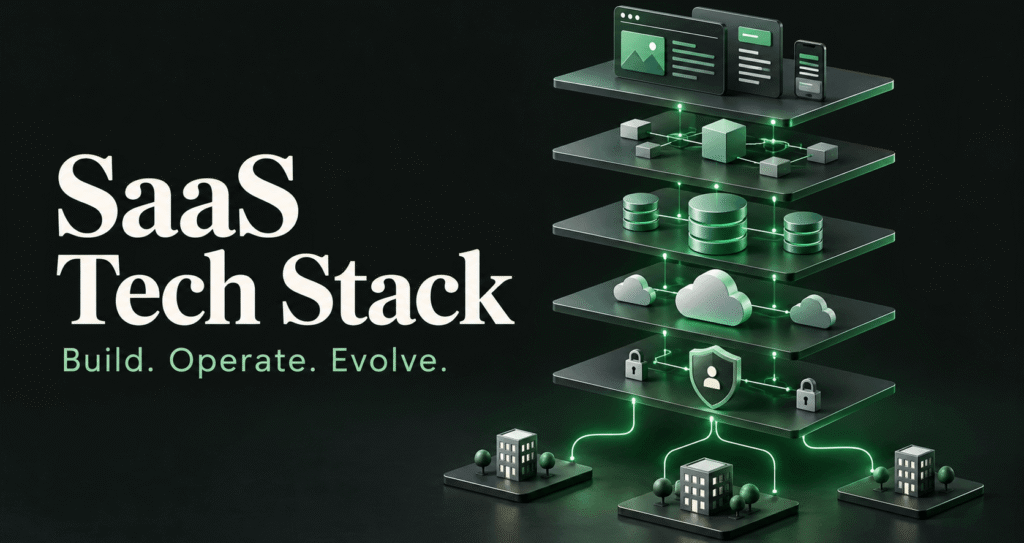
A SaaS stack needs more than a frontend and a backend. It must connect customer workflows, business rules, data, and operations. Each layer has a specific job. Choose its tools around that job, then check how the layers work together.
Frontend and User Experience
The frontend turns product workflows into screens customers can use. React or Vue can support dashboards and interactive interfaces. Next.js adds a React framework with rendering and routing options. Start with accessible forms, clear navigation, and usable loading and error states.
 Next.js
 VueTypeScript
Introduce live updates or offline behavior when customer workflows require them. A dashboard does not automatically need either.
Backend, APIs, and Background Jobs
The backend validates requests, applies business rules, and connects systems. Node.js, Python, and .NET offer different ecosystems for this work. Your choice should reflect workload and team experience. Establish API boundaries, input validation, and predictable error handling from the start.
 Node.js
 Python
 .NET
Move slow imports, document processing, and similar tasks into background workers. Define retries and duplicate handling before adding queues.
Databases, File Storage, and Caching
Databases preserve application records; object storage handles files. PostgreSQL is a common option for relational data and transactions. Start with a clear data model, tenant boundaries, and tested backups. Database features can support isolation, but configuration and application behavior still matter.
 PostgreSQL
 Redis
Add caching after identifying expensive repeated reads. Define expiration and invalidation so faster responses do not serve incorrect data.
Cloud Hosting, Deployment, and Observability
Hosting runs the application. Deployment delivers changes. Observability combines logs, metrics, and traces to explain failures. AWS and Azure provide managed infrastructure options. Start with separate environments, controlled releases, useful alerts, and a documented recovery process.
 AWS
 Azure
 Docker
Expand monitoring as workloads become more complex. Compare SaaS stacks by operational effort as well as development convenience.
Authentication, Billing, and Product Integrations
Authentication verifies identity; authorization controls access. Billing connects subscriptions with product entitlements. Managed identity services and Stripe can support these workflows. Start with tenant-aware permissions, subscription event handling, and secure integration credentials.
 Auth0
 Stripe
Add enterprise SSO or advanced billing models when buyers require them. Plan for failed payments, delayed events, and unavailable external services.
| Layer | Responsibility | Selection criteria |
|---|---|---|
| Frontend | Customer interactions | Workflows, accessibility, rendering |
| Backend | Rules and processing | Workload, integrations, team expertise |
| Data | Records and files | Consistency, isolation, recovery |
| Infrastructure | Delivery and operations | Availability, cost, operational ownership |
| Identity & integrations | Access and subscriptions | Permissions, lifecycle events, reliability |
A coherent SaaS software stack connects these decisions. VortDev’s discovery and architecture planning cover workflows, data, access, integrations, and infrastructure together, helping you identify missing requirements before implementation.
Discuss your SaaS architectureHow to Compare Frontend and Backend Technologies
However, comparing SaaS stacks starts with your product’s workflows and the team responsible for delivering them. A technology can fit the requirements and still create problems if nobody can maintain it confidently. Ask each development partner to explain the proposed combination, its limitations, and the alternatives considered.
Choose the interface and the backend separately, then validate how they work together.
Start with user workflows, public-page rendering, accessibility, and team experience.
Compare complete approaches against business rules, integrations, background work, and operational requirements.
These are options to evaluate, not a speed ranking. Each can support multiple product types.
React, Next.js, and Vue: Match Rendering to Product Needs
Additionally, React is a library for building interfaces from reusable components. Next.js is a framework built on React, adding conventions and capabilities for routing, rendering, and server-side work. They are not competing choices at the same level. Vue is a frontend framework that can also support interactive applications.
A dashboard behind a login has different rendering needs from a public marketplace. Search visibility matters for public pages; authenticated workflows may depend more on interaction speed and state management. Neither requirement automatically determines the whole architecture.
Your SaaS software stack should support these differences without adding unnecessary complexity. For example, a product can use server-rendered public pages alongside highly interactive account screens.
Node.js, Python, and .NET: Compare Team and Workload Fit
Node.js is a JavaScript runtime. Python is a programming language, usually paired with a framework such as Django or FastAPI. .NET is a development platform commonly used with C# and ASP.NET Core. Comparing them requires evaluating the complete backend approach.
| Option | Practical fit and advantages | Limitations to evaluate |
|---|---|---|
| React with Next.js | React interfaces with integrated routing and rendering options | Server/client boundaries, caching behavior, deployment requirements |
| Vue | Component-based interfaces supported by a Vue-experienced team | Required integrations, team availability, companion tooling |
| Node.js | JavaScript or TypeScript teams building APIs and integration workflows | CPU-heavy work must not block request processing |
| Python with Django or FastAPI | Business applications, data processing, or Python-based AI integrations | Framework differences, concurrency model, background processing |
| .NET with ASP.NET Core | C# teams, structured business domains, Microsoft integrations | Hosting approach, dependency choices, team expertise |
These are evaluation starting points, not performance rankings. A reporting product might need background workers regardless of its backend language. An integration-heavy platform needs reliable retries and failure handling regardless of its framework.
Evaluate Ecosystem, Hiring, and Long-Term Maintenance
A search for “tech stack SaaS” can produce convincing recommendations without revealing who will support the result. Before choosing, check required SDKs, dependency maintenance, upgrade paths, and available engineering skills. Validate hiring assumptions against your budget and recruitment market.
At VortDev, technology selection forms part of discovery and architecture planning. We connect it with product scope, integrations, and delivery requirements. That gives you a proposal to evaluate against business needs, rather than a list of preferred tools.
Choose Data and Tenant Architecture Before Adding Complexity
Your data model determines how customer information is stored, connected, and protected. These decisions deserve attention before adding more infrastructure. A SaaS software stack can use familiar technologies and still expose customer data if tenant boundaries are poorly enforced.
Relational Data, Documents, and Specialized Storage
Relational databases suit records with defined relationships and consistency requirements, such as organizations, invoices, subscriptions, and permissions. Document storage can suit particular access patterns, but flexible records do not automatically require a separate document database.
Choose storage around how the application reads and updates information. Files usually belong in object storage, with ownership and metadata recorded separately. Search indexes or analytical stores become useful when specific workloads justify them.
The tool alone does not establish the architecture. PostgreSQL, for example, supports row-level security, but policies and database roles require careful configuration. Application access paths still need review.
Shared Database, Separate Schemas, or Separate Databases?
A shared database with shared tables can simplify operations, but every tenant-owned record needs a reliable ownership model. Access controls must enforce that model across queries, exports, administrative tools, and background jobs.
Separate schemas create clearer logical boundaries, while increasing migration and management work. Separate databases allow more independent backup, restoration, and configuration. However, they also increase provisioning and operational overhead. Sharing the underlying database infrastructure can still create resource contention.
There is no universal winner. Microsoft’s multitenant guidance treats isolation, scale, cost, and manageability as competing design considerations.
Consider a B2B reporting workflow. The application verifies the user, checks organization membership, and authorizes the requested report. A background job then carries the tenant context into data access and file generation. Download permissions must protect the finished export too.
That complete workflow matters more than choosing an isolation label. Our multi-tenant platform development services address tenant architecture alongside access controls and product requirements. The goal is to establish workable boundaries before customer onboarding makes changes harder.
When Caching and Queues Become Necessary
If “tech stack SaaS” research leads you to add Redis immediately, first identify the problem it would solve. Caching can reduce repeated expensive reads, but it introduces expiration and invalidation decisions. Incorrect cache keys can also expose one tenant’s results to another.
Queues help move slow or retryable work outside the request-response flow. Examples include imports, exports, and external synchronization. Workers need duplicate handling, failure visibility, and preserved tenant context.
Add these components when measured bottlenecks or workflow requirements justify them. A simpler SaaS tech stack is easier to operate when it already meets the product’s needs.
Modular Monolith, Microservices, or Serverless?
Architecture determines how responsibilities are organized and deployed. It is a related decision to choosing a tech stack for SaaS, but it is not the same decision. Microservices describe service boundaries; serverless describes an execution and operational model. A product can combine both.
When a Modular Monolith Fits an Early SaaS Product
A modular monolith keeps clearly separated business modules within one deployable application. It can simplify releases, local development, testing, and debugging while product requirements are still changing.
The important word is “modular.” Billing, account management, and reporting need defined interfaces and ownership. Without those boundaries, a single application can become difficult to change safely.
For a founder evaluating a “tech stack SaaS” recommendation, ask whether the proposed complexity solves a current problem. An early product rarely benefits from distributing every feature before its workflows are understood.
What Justifies Independent Services?
Separate services become useful when a module needs independent deployment, scaling, or ownership. A document-processing workload, for example, may require different resources from ordinary account requests.
Concrete triggers include sustained resource contention, release dependencies that block teams, or a need to contain particular failures. Registered-user counts alone do not establish any of these conditions.
Microservices also introduce network failures, distributed tracing, data consistency decisions, and more deployment coordination. Microsoft’s architecture guidance identifies these operational challenges alongside the benefits of independent services.
Serverless Trade-Offs for Your Workload
Serverless functions can suit event-driven tasks and workloads with uneven demand. Evaluate execution limits, startup latency, concurrency, database connections, and pricing under realistic usage. AWS also recommends idempotent processing, so repeated events do not create unintended duplicate effects.
Portability needs consideration too. Business logic may remain portable, while provider-specific triggers and infrastructure require migration work.
Your SaaS tech stack should reflect who will operate these components after launch. VortDev’s architecture planning considers infrastructure, integrations, access logic, and scalability together. This helps connect the proposed design with both delivery requirements and ongoing operations.
SaaS Stack Examples for Different Product Scenarios
A SaaS tech stack becomes easier to evaluate when you connect its components to a specific product. The configurations below are reference examples, not descriptions of completed VortDev projects. Each illustrates a possible approach, the requirements behind it, and the trade-offs to examine before implementation.
A Lean SaaS MVP
Consider a subscription product that helps small teams manage recurring tasks. Its first release needs accounts, a shared workspace, task management, and simple billing. The priority is testing whether customers will pay for the workflow.
A reference configuration could combine Next.js and TypeScript, PostgreSQL, managed authentication, and Stripe. A managed hosting platform can reduce initial infrastructure work. Application logic can remain within a modular codebase, with background processing added for tasks that cannot reliably complete during a request.
This approach limits the number of systems the team must coordinate. Relational storage supports accounts, tasks, and subscriptions, while managed services handle selected operational responsibilities.
The limitations still need review. Hosting constraints, identity-service pricing, and billing integration effort can affect the budget. As usage grows, the team might separate scheduled processing or increase database capacity. These changes should follow measured needs, rather than an assumed requirement to rebuild after launch.
A Multi-Tenant B2B Workflow Platform
A platform for approvals and document workflows needs organization accounts, employee roles, audit records, and business integrations. Customers may also require configurable workflows and separate access policies.
React with Next.js or Vue could support the interface. A backend using Node.js with a structured framework, or .NET with ASP.NET Core, could manage business rules. PostgreSQL could store tenant-owned records, while object storage holds documents. Background workers could process exports, notifications, and synchronization.
The value of this combination depends on consistent tenant context across each operation. A user’s organization must remain identifiable when a request becomes a background job or downloadable file.
Shared infrastructure can simplify operations, but isolation requires deliberate enforcement. Large customer imports can also compete with ordinary requests. The growth path might include workload limits, separate worker capacity, or dedicated resources for particular customers.
VortDev’s multi-tenant platform development services address these decisions alongside permissions, integrations, and product requirements.
A Data-Heavy or AI-Enabled SaaS Product
Consider a product that processes uploaded documents and helps users find relevant information. It needs file storage, asynchronous processing, access controls, and clear visibility into failed jobs.
A reference setup could use React, Python with FastAPI, PostgreSQL, object storage, and background workers. An external model API could support extraction or summarization. Vector search may be useful if semantic retrieval is part of the workflow.
This tech stack for SaaS separates interactive requests from longer processing tasks. Python-based components can also integrate with data-processing libraries where those libraries fit the requirements.
However, adding AI introduces evaluation, latency, privacy, and usage-cost questions. A model response is not automatically accurate or suitable for customer decisions. The team needs representative test cases and a fallback when processing fails.
As demand grows, workers can scale independently. Specialized search infrastructure becomes relevant when measured retrieval requirements exceed the initial approach.
An Enterprise Product with Existing Microsoft Integrations
An enterprise workflow product may need Microsoft Entra ID sign-in, connections to Microsoft services, and detailed access records. A possible SaaS technology stack includes React, ASP.NET Core, Azure hosting, and a managed relational database.
This configuration can fit a team already working with C# and Azure. Microsoft’s identity platform supports OpenID Connect authentication, although application permissions and tenant access remain separate implementation decisions.
The constraints include customer consent, integration permissions, procurement requirements, and responsibility for operating the environment. Existing Microsoft relationships can influence the choice, but they do not remove the need to evaluate cost and product fit.
Future development might introduce dedicated customer environments or additional integrations. Those options require documented deployment and configuration processes.
VortDev’s discovery and architecture planning connect these choices with scope, delivery, and ongoing support. That helps you assess a configuration before committing to the full build.
Discuss Your SaaS Architecture
Security, Authentication, and Billing Requirements
Security and billing requirements affect your tech stack for SaaS before development begins. They influence the data model, identity integration, customer onboarding, and operational processes. Leaving these decisions until launch can create changes across several components.
Authentication Is Different from Authorization and Tenant Isolation
Authentication establishes who a user is. Authorization determines which actions that user can perform. Tenant isolation protects one customer organization’s resources from another.
These responsibilities overlap, but they are not interchangeable. AWS explicitly distinguishes tenant isolation from authentication and authorization. A signed-in user must still remain within the correct tenant boundary.
For example, an administrator may invite colleagues within their organization without gaining access to another organization’s accounts. Your SaaS technology stack must enforce that distinction in APIs, background jobs, file downloads, and administrative tools.
Subscription Billing, Entitlements, and Webhook Reliability
A subscription records the commercial relationship. Entitlements describe the features or limits available under that relationship. User permissions then determine who can use those features.
A paid plan might enable exports for an organization, while only selected roles can initiate them. A payment failure should trigger the agreed access policy, including any grace period.
Billing events also require reliable processing. Stripe documents signature verification, duplicate events, retries, and delivery-order considerations for webhook integrations. Your application should not assume every event arrives once or in sequence.
Test upgrades, cancellations, failed payments, and delayed notifications. Reconcile billing records with product access when necessary.
Enterprise Security and Compliance Requirements
Enterprise customers may require SSO, audit trails, data retention controls, or particular hosting arrangements. Identify these expectations during discovery, including which requirements apply to the initial release.
A SaaS stack does not become compliant simply because it uses a particular framework or cloud provider. Configuration, contracts, access management, operational procedures, and evidence all matter.
VortDev’s architecture planning covers access logic, integrations, and infrastructure together. This helps connect customer requirements with implementation scope instead of treating security as a final checklist.
How Your SaaS Stack Affects Development and Operating Costs
The cost of a SaaS stack extends beyond its initial development estimate. Your budget must cover running the application, supporting customers, updating dependencies, and recovering from failures. A low-cost launch can become expensive if it leaves essential operational work unresolved.
Initial Development and Integration Effort
Engineering effort depends on workflows, data relationships, permissions, integrations, and testing requirements. Familiar tools can reduce implementation uncertainty, but they do not eliminate product complexity.
Compare proposals against the same scope. One estimate may include billing failures, migration tooling, and deployment automation. Another may cover only the main screens and successful user flows.
At VortDev, discovery includes product requirements, architecture direction, integration risks, and an initial roadmap. These inputs help make the development estimate more specific before implementation starts.
The hourly rate is only one variable. Rework, coordination, and maintenance can change the total cost considerably.
Infrastructure, Third-Party Services, and Maintenance
A useful planning model is:
Total cost over a defined period = initial engineering + cloud infrastructure + external services + operations and support + planned upgrades.
Keep these categories separate to avoid counting the same work twice. For example, ongoing engineering may already include dependency updates.
Your SaaS technology stack determines which costs are fixed and which grow with usage. Managed identity may charge by users or enterprise connections. AI services may charge by processing volume. Storage, network traffic, database capacity, and observability also need consideration.
Compare SaaS stacks using the workloads they will actually support. Open-source software can reduce license costs, but hosting and maintenance still require resources. Managed services can reduce operational work while introducing pricing limits or migration dependencies.
Compare Costs Under Different Workload Scenarios
Start with a baseline, a plausible growth scenario, and a peak-demand scenario. The following examples are planning inputs, not provider prices or customer benchmarks.
| Scenario | Illustrative workload | Costs to investigate |
|---|---|---|
| Baseline | 100 organizations, 20 GB of files, 500 daily background jobs | Minimum infrastructure, identity, backups, support |
| Growth | 1,000 organizations, 200 GB of files, 5,000 daily jobs | Database capacity, workers, storage, service tiers |
| Peak demand | Five times normal concurrent activity during imports | Temporary capacity, queue behavior, rate limits |
Define request complexity, processing duration, retention, and availability expectations before calculating a budget. Two products with the same user count can have very different operating costs.
Use current provider quotes or calculators against these assumptions, then validate important estimates through testing. Track cost per organization, completed workflow, or processed document where appropriate.
Our SaaS development services combine architecture planning, deployment, and ongoing support. That connects technology selection with the resources needed to keep the product working after launch.
Common SaaS Tech Stack Mistakes and How to Avoid Them
Most costly stack mistakes begin with an assumption nobody checks. The problem becomes visible later, when a release slows down or an integration proves harder than expected. Before accepting a recommendation, ask what evidence supports it and what would make the team reconsider.
Copying Another Product’s Stack
A successful product’s SaaS stack reflects its history, workload, and engineering resources. Copying its components does not reproduce those conditions. You may inherit complexity without needing the capabilities that justified it.
Consider an illustrative scenario: a small approval-workflow MVP adopts the distributed architecture of a global collaboration platform. The team spends its launch budget coordinating services instead of testing the customer workflow.
Compare requirements before copying technologies. Keep components that solve your problem, and ask the team to justify the rest.
Adding Tools Before Identifying the Need
Comparisons of SaaS stacks often present caching, queues, and specialized databases as standard ingredients. Adding them without a defined purpose creates more configuration, monitoring, and failure handling.
Check each proposed tool against a requirement or measured bottleneck. Identify the expected improvement and how the team will verify it. If neither is clear, postpone the addition.
Ignoring Team Ownership, Upgrades, and Migration Paths
A SaaS software stack becomes fragile when one developer understands its critical components. Poor documentation and unmanaged dependencies can make routine changes risky.
Before development, establish ownership of repositories, cloud accounts, deployment processes, and credentials. Ask who handles updates and how another engineer can take over. For external services, review export options and the effort required to replace them.
VortDev’s delivery model includes architecture planning, deployment, and ongoing product support. Discuss these responsibilities during discovery so the proposed solution includes operating the product after launch.
Validate Your Stack and Evaluate a Development Partner
A recommendation is useful when you can trace it from requirements to evidence. Comparing SaaS stacks by their technology names alone leaves the important questions unanswered. You need to understand what the team has verified, what remains uncertain, and who owns the risks.
Test the Riskiest Assumptions with a Focused Prototype
A technical prototype should answer a specific question before full implementation. Can the required integration handle the workflow? Can a representative query meet the response-time target? Does the proposed isolation approach protect tenant-owned resources?
Define the acceptance criteria before building the prototype. Use realistic data and include relevant failure conditions. Record latency, error rates, resource consumption, and any limitations discovered. A successful demonstration with a few sample records does not establish production capacity.
Questions to Ask About the Proposed Architecture
Turn a broad “tech stack SaaS” search into a concrete conversation with the development team:
- Why does this combination fit our workflows and constraints?
- Which alternatives did you reject, and why?
- Which assumptions have been tested?
- Where are the expected bottlenecks?
- Who will maintain the application and infrastructure?
- What would trigger a change, and what would that change involve?
Ask for examples and supporting documents. For broader delivery and team-selection criteria, use our guide to choosing a SaaS development company.
Record Decisions, Alternatives, and Review Triggers
An Architecture Decision Record explains why a significant choice was made. Microsoft recommends recording the context, alternatives, outcome, and consequences. When the decision changes, a new record preserves that history.
For example, an illustrative record might propose a shared PostgreSQL database for an early B2B product. The rationale is simpler operations; the trade-off is stricter access enforcement. Validation remains pending until tenant-isolation and workload tests pass. Dedicated customer resources become a review trigger if contractual requirements change.
Your SaaS software stack should come with understandable reasoning. VortDev’s discovery work includes requirements, architecture direction, integration risks, and delivery planning. That provides a basis for discussing uncertainties before committing to implementation.
SaaS Tech Stack FAQ
The best SaaS tech stack meets your product requirements and remains practical for the team operating it. Start with workflows, data, integrations, security, and budget. Then compare proven options against those constraints.
A familiar combination can reduce learning overhead. However, familiarity alone is insufficient if required integrations or workload characteristics make it unsuitable. Request a documented rationale and tests for the assumptions that matter most.
A minimum SaaS software stack needs an interface, application logic, data storage, hosting, and appropriate access controls. It also needs a workable release process, failure visibility, and recovery arrangements.
Subscriptions, payments, background processing, and external integrations depend on the product’s scope. Several responsibilities can share one framework or managed service. “Minimum” should mean enough to operate safely, rather than the fewest possible technology names.
Some core technologies may remain suitable throughout the product’s growth. What changes is often the surrounding architecture, capacity, controls, and operational process.
An MVP needs the essential customer workflow and a credible development path. Enterprise requirements may introduce SSO, audit trails, deployment restrictions, or contractual availability targets. Identify likely requirements early, but avoid implementing every hypothetical feature before validating demand.
Sometimes. A well-defined module, integration, or deployment component may be replaceable independently. Changes involving data models, identity, or tightly coupled business logic can affect much more of the application.
Evaluate migration scope, compatibility, data movement, and rollback before deciding. A staged replacement can reduce disruption, but it still requires engineering and testing. The first question is whether targeted improvements would solve the problem more economically.
No. AI needs a useful product application, representative evaluation, and acceptable privacy, latency, and cost characteristics. Kubernetes manages containerized workloads, but operating it introduces additional responsibilities. Its capabilities should match actual deployment needs.
A managed application platform may be sufficient for your current workload. Adopt additional infrastructure when the benefits justify the operational effort and the team can support it.
Compare both proposals against the same requirements, workload assumptions, and delivery scope. Include integration effort, maintenance, infrastructure, ownership, and migration options.
A “tech stack SaaS” shortlist cannot reveal these differences by itself. Ask each team to explain rejected alternatives and unresolved risks. Where recommendations conflict, a focused prototype can provide evidence. At VortDev, discovery and architecture planning help connect those decisions with the product you need to deliver.
Choose a SaaS Stack You Can Build, Operate, and Evolve.
Have a product idea or conflicting technology recommendations? Turn those questions into a development plan grounded in your workflows, integrations, and budget.
VortDev’s discovery and architecture planning connect your SaaS tech stack with product requirements, technical risks, and delivery priorities.
Discuss Your SaaS Tech StackBring your idea, existing platform, or proposed stack. A finished specification is not required.
What to Prepare for a Technical Discovery Discussion
-
01
What are you building? Product stage, core workflows, and target launch.
-
02
What must it connect to? Integrations, existing technologies, and tenant requirements.
-
03
What needs a second opinion? Architecture choices, operating costs, or delivery risks.